

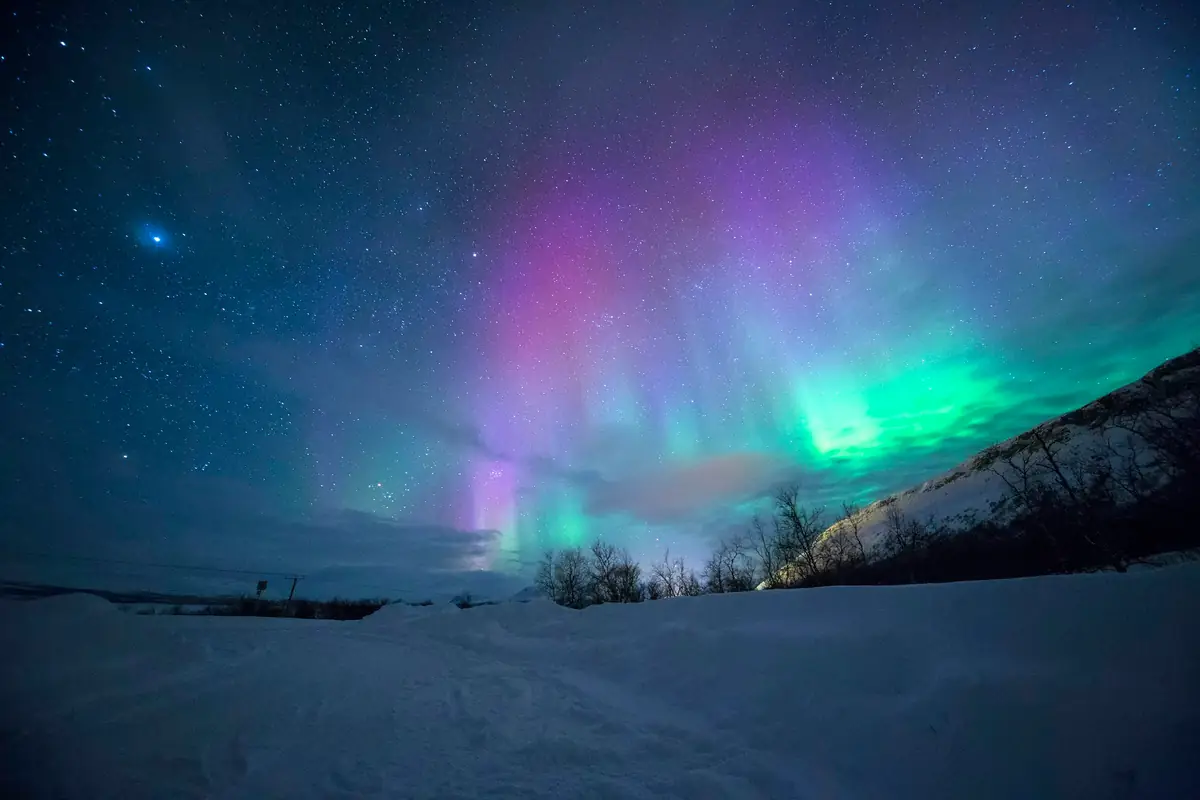
What are the northern lights?
Coloured lights that appear in the night sky near the North Pole when charged particles from the sun collide with gases in the atmosphere: oxygen gives the famous green, and nitrogen gives pink and purple. They appear close to the Arctic Circle, in northern Norway, Finland, Sweden, Iceland, Russia and Canada.
When to see them
- From September to late March, when the nights are long and dark.
- The best hours are usually between 10 pm and 2 am.
- You need a clear sky away from city lights, and moonless nights are clearer.
- Plan three to five nights to improve your chances, as it's a natural phenomenon that can't be guaranteed.
Tromsø (Norway): the aurora capital
A city above the Arctic Circle among mountains and fjords, and the world's biggest base for northern lights trips. The best time is November to February. Reach it via Oslo, with flights from Istanbul or Doha, then a short domestic flight.
Lapland (Finland): the aurora from your glass igloo
Rovaniemi and Santa Claus Village, Levi, Saariselkä and Inari, with glass igloos where you can watch the aurora from your bed. It appears on about 150 nights a year, from late September to March. Reach it via Helsinki, or on Turkish Airlines' seasonal flights from Istanbul to Rovaniemi from 8 December 2026 to 7 March 2027.
Abisko (Sweden): Europe's clearest sky
A national park known for its "blue hole", a patch of sky that often stays clear when clouds surround it, and for the Aurora Sky Station on Mount Nuolja. The best time is December to March, and nearby Kiruna has its famous Icehotel.
Iceland: aurora over mountains and waterfalls
Volcanic landscapes, waterfalls and glacier lagoons, and the aurora over Kirkjufell or the Jökulsárlón lagoon is one of the world's great sights. The best time is October to March.
Murmansk (Russia): the aurora without a visa
In Russia's far north, with the village of Teriberka on the Barents Sea nearby. The advantage: Russia has been visa-free for Saudis since May 2026 (with advance registration in the RuID app), and you travel via Moscow. Remember that international bank cards and WhatsApp don't work there.
How to prepare
- Dress in layers: thermal, then wool, then a windproof jacket, as temperatures can drop to −20° in Lapland.
- Waterproof winter boots, gloves, a hat and wool socks.
- Follow the aurora forecast (the Kp index) and the cloud forecast in weather apps.
- For photos: a tripod and manual settings with a long exposure; recent phones capture it in night mode.
- Choose a hotel that wakes you if the aurora appears, or a glass igloo.
Visa and booking
Norway, Finland, Sweden and Iceland are Schengen countries, so you need a Schengen visa from the country where you'll spend the most nights. We find you flights, hotels and glass igloos at the lowest available rates, and prepare your visa file.
Frequently asked questions
When do the northern lights appear?
From September to March, usually between 10 pm and 2 am, on a clear night away from city lights.
Where is the best place to see the northern lights?
Tromsø in Norway, Finnish Lapland, Abisko in Sweden, Iceland and Murmansk in Russia.
Can you guarantee seeing the northern lights?
No, it's a natural phenomenon that depends on solar activity and clear skies, but staying 3 to 5 nights in season greatly improves your chances.
Do Saudis need a visa for a northern lights trip?
Yes for the Nordic countries (a Schengen visa), and no for Russia since May 2026.
Read next
- Autumn break 1448: 6 destinations for 20–28 November
- Makkah hotels for Ramadan Umrah 1448: when to book
- Eid al-Fitr break 2027: where to go in 16 days
Published 6 October 2026, last updated 6 October 2026. The information is for guidance only; entry requirements and seasons can change, and the binding price is the one in your booking confirmation.